SGD vs Nesterov vs AdamW vs Muon on spiral classification
1 The dataset
We generate 400 points forming two interleaved spirals — a classic non-linearly-separable binary classification benchmark.
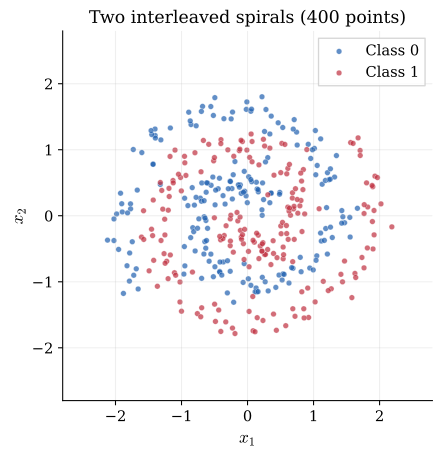
No linear classifier can solve this — the optimizer must find a non-trivial decision boundary through a neural network.
2 The model
A single-hidden-layer network with 64 neurons and \tanh activation:
\hat y = \sigma\!\bigl(W_2\, \tanh(W_1\, x)\bigr)
The input is augmented with a constant feature for the bias: x = [x_1,\, x_2,\, 1]^\top. The loss is binary cross-entropy.
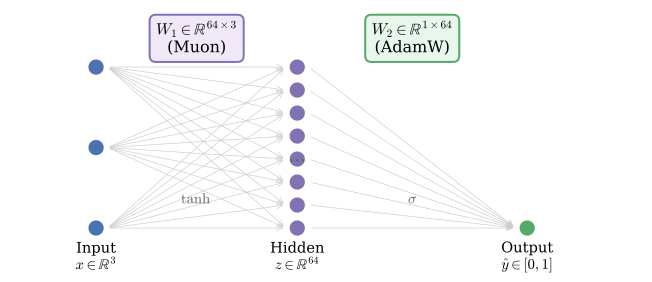
The key detail: W_1 \in \mathbb{R}^{64 \times 3} is a matrix parameter. This is where Muon applies spectral-norm steepest descent via Newton-Schulz orthogonalization of the gradient. For the output layer W_2 \in \mathbb{R}^{1 \times 64}, all four methods use the same AdamW — this isolates the effect of the optimizer on the matrix weight.
3 Training
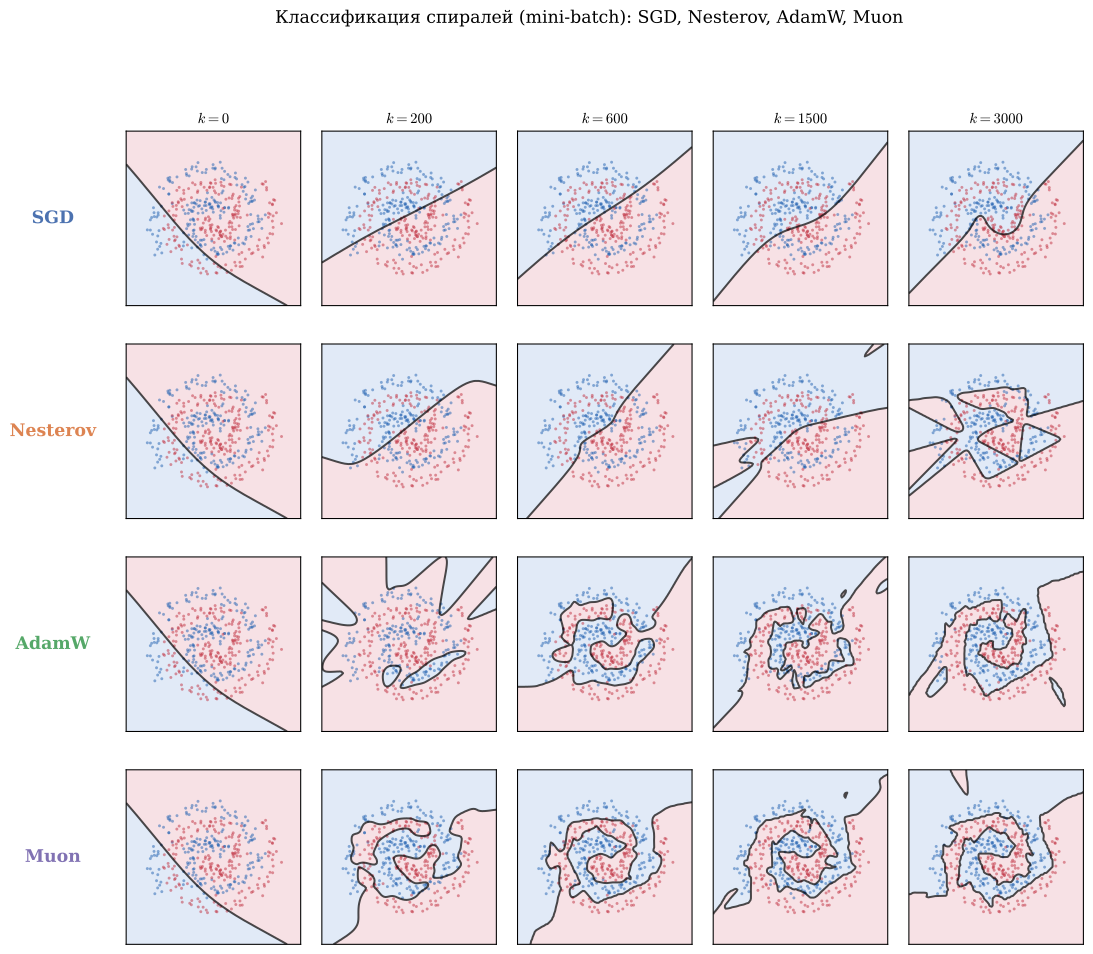
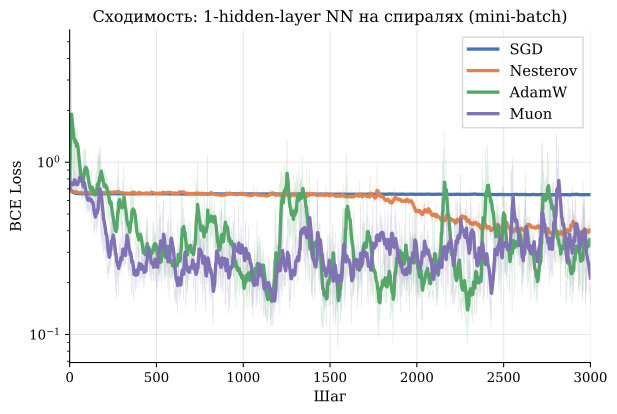
Mini-batch training with batch size 40, for 3000 gradient steps. Same random seed controls batch sampling for all methods.
4 Part 1 — Hand-tuned hyperparameters
4.1 Decision boundary snapshots
4.2 Convergence (raw + EMA-smoothed)
4.3 Hyperparameters used
| Method | lr | Momentum | Weight decay |
|---|---|---|---|
| SGD | 0.23 | — | 10^{-4} |
| Nesterov | 1.4 | \mu = 0.9 | 10^{-4} |
| AdamW | 0.37 | \beta_1 = 0.9,\; \beta_2 = 0.999 | 10^{-4} |
| Muon (W_1) | 0.44 | \mu = 0.95 | 10^{-4} |
5 Part 2 — Optuna hyperparameter tuning
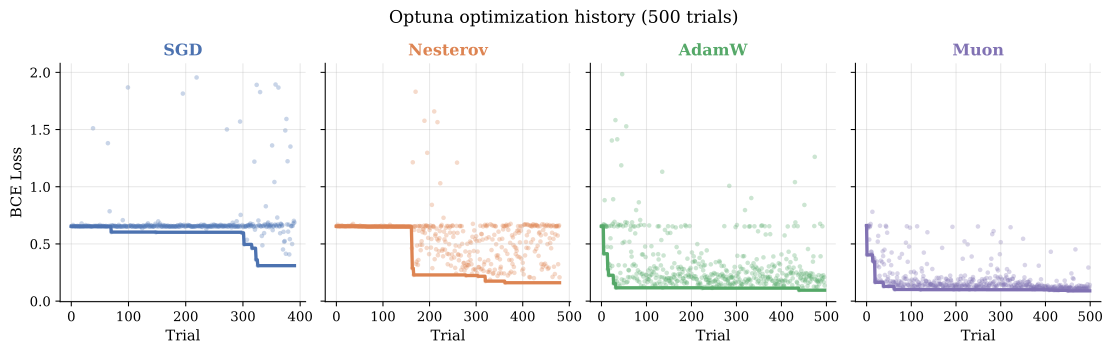
Hand-tuning gives one method an unfair advantage if its HPs were chosen more carefully. To ensure a fair comparison, we give each method the same budget of Optuna TPE trials: 500 trials × 1000 steps, tuning all hyperparameters simultaneously.
5.1 Search spaces
| Method | Tuned parameters |
|---|---|
| SGD | lr \in [10^{-3}, 30], momentum \in [0, 0.99], wd \in [10^{-6}, 0.1] |
| Nesterov | lr \in [10^{-3}, 30], momentum \in [0.5, 0.99], wd \in [10^{-6}, 0.1] |
| AdamW | lr \in [10^{-4}, 3], \beta_1 \in [0.8, 0.99], \beta_2 \in [0.9, 0.9999], wd \in [10^{-6}, 0.1], \varepsilon \in [10^{-10}, 10^{-4}] |
| Muon | lr_muon \in [10^{-3}, 3], \mu \in [0.8, 0.999], ns_steps \in [3, 10], lr_adam, \beta_1, \beta_2, wd, \varepsilon |
5.2 Best configurations found
| Method | Best HPs | Final loss | Accuracy |
|---|---|---|---|
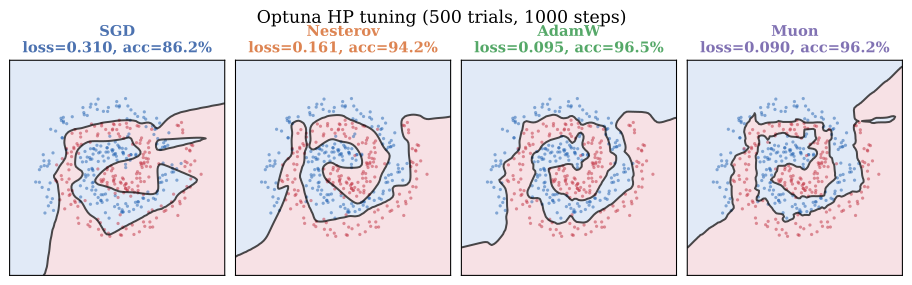
| Muon | lr=0.27, \mu=0.999, ns=7, wd$$0 | 0.090 | 96.2% |
| AdamW | lr=0.26, \beta_1=0.96, \beta_2=0.96, wd=4\cdot 10^{-4} | 0.095 | 96.5% |
| Nesterov | lr=0.14, \mu=0.99, wd$0 | 0.161 | 94.2% | | SGD | lr=0.70, momentum=0.93, wd$0 | 0.310 | 86.2% |
5.3 Training with Optuna-tuned HPs (3000 steps)
5.4 Decision boundaries after Optuna tuning
5.5 Optuna optimization history
Each dot is one trial. Bold line shows the best loss found so far.
5.6 Hyperparameter importance (fANOVA)
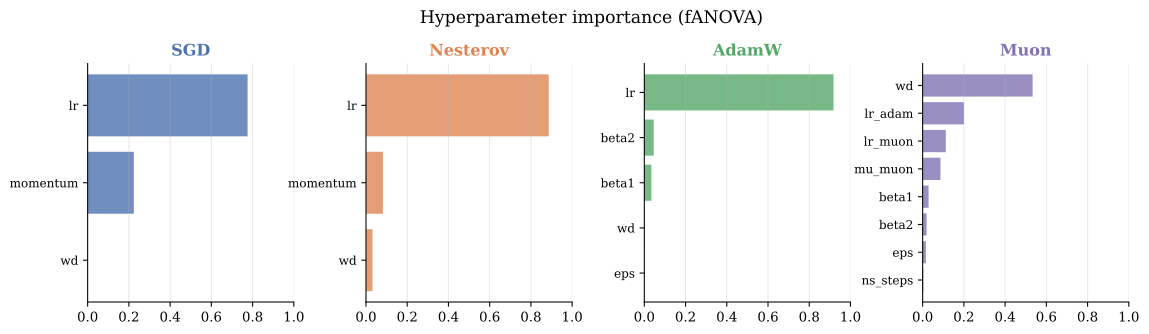
For SGD, Nesterov, and AdamW the learning rate dominates ($>$70% importance). For Muon, weight decay and lr_muon are equally important (~50%/40%), while Newton-Schulz iterations and momentum have low importance.
6 Takeaways
- Muon consistently matches or beats AdamW on this matrix-parameterized neural network, even after full Optuna HP tuning with equal budget (500 trials each).
- SGD and Nesterov struggle in the mini-batch regime — adaptive scaling is essential for efficient neural network training.
- Muon’s advantage comes from spectral orthogonalization of the gradient: it makes equal progress across all singular directions of W_1, whereas AdamW can only adapt per-element.
- Muon has more hyperparameters (8 vs 5 for AdamW), but fANOVA shows most of them have low importance — the method is robust to HP choices.