Lipschitz continuity
1 Lipschitz continuity of a function
A function f: \mathbb{R}^n \to \mathbb{R} is called G-Lipschitz continuous on a set S if there exists a constant G \geq 0 such that for all x, y \in S:
|f(x) - f(y)| \leq G \|x - y\|
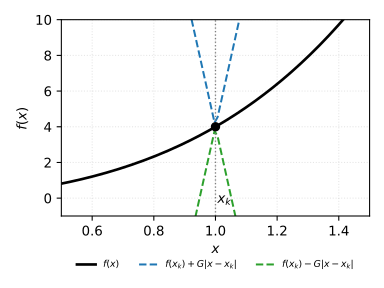
Geometrically, the Lipschitz condition means the function graph lies inside a cone of slope G centered at any point (x, f(x)). The animation below illustrates how moving the reference point shifts the cone while the function always remains inside it.
2 L-smoothness and the descent lemma
A function f is called L-smooth if its gradient is L-Lipschitz continuous:
\|\nabla f(x) - \nabla f(y)\| \leq L \|x - y\|
An equivalent characterization is the descent lemma: for all x, y,
f(y) \leq f(x) + \langle \nabla f(x), y - x \rangle + \frac{L}{2} \|y - x\|^2
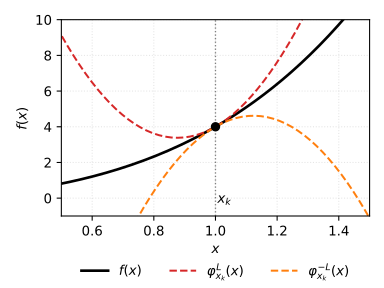
This means the function is always bounded above by a parabola with curvature L tangent at any point. The animation shows how moving the tangent point shifts the bounding parabola while the function stays below it.
3 Strong convexity and smoothness bounds
When a function is both \mu-strongly convex and L-smooth, its Hessian satisfies:
\mu I \preceq \nabla^2 f(x) \preceq L I
This gives two-sided quadratic bounds at every point:
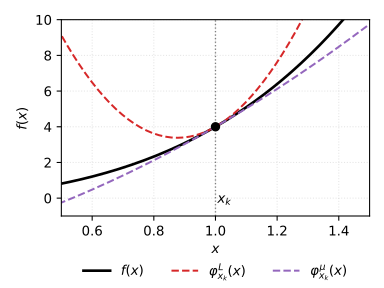
f(x) + \langle \nabla f(x), y - x \rangle + \frac{\mu}{2}\|y-x\|^2 \leq f(y) \leq f(x) + \langle \nabla f(x), y - x \rangle + \frac{L}{2}\|y-x\|^2
The ratio \kappa = L / \mu is the condition number, which determines convergence rates of optimization methods. The animation shows how the function is sandwiched between a lower parabola (strong convexity) and an upper parabola (smoothness) at each point.